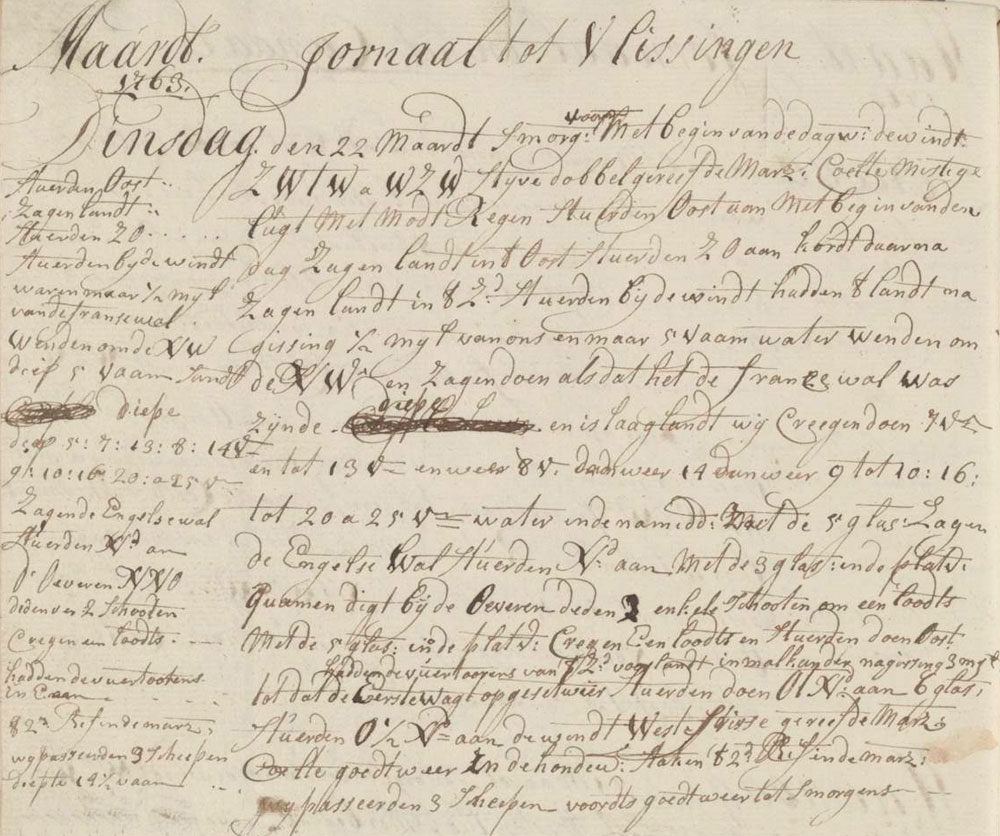
In the morning, at the beginning of the morning watch, there was a SW by W to WSW stiff
Sail of which the surface area has been reduced two times in order to make the surface area smaller.double-reefed top sail breeze, foggy skies with drizzle; we steered towards the east. With the beginning of the day we saw land in the east, steered SE, and soon afterwards we saw land in the S. We steered with the wind and saw the land at and estimated ½ mile from us, with only 5
fathom1 fathom = 6 feet (170 com)fathoms of water. We came about NW and saw then that it was the French coast:
DieppeNormandy, FranceDiepe, which is low lying country. We then had 7 fathoms of water, later up to 13 fathoms, and again 8 fathoms, then up to 14, then back to 9 till 10, 16 till about 20 to 25 fathoms of water. In the afternoon, when 5 glasses had run out, we saw the English coast and steered N. When 3
The length of the watches was measured using an hourglass filled with sand. Each watch consisted of 8 half-hour glasses, marked by bells.glasses in the dog watches had run out we came close to
DoverEngland, United KingdomDoeveren and fired two single shots for a pilot. When 5 glasses in the dog watches had run out we got a pilot and steered towards the east. We had the lighthouses of
South ForelandKent, England, United Kingdom‘t Zuid-Voorlandt on one line at an estimated distance of 3 sea miles – until the first watch began. Then we steered E by N, and with 6 glasses E½N. T he wind was a west, strong reefed topsail breeze with good weather. In the middle watch we
to reefTo reduce the surface area exposed to the wind.reefed a second topsail. We passed three ships, depth: 14 ½ fathom. Good weather till the morning.
Read more
– beached on 23 March
– the final settlement